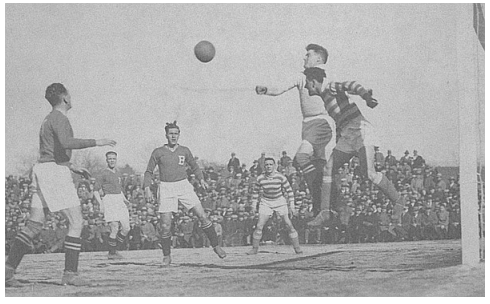
In the United States, soccer communities often formed in industrial centres where immigrants from from Britain typically made up the ranks of company owned teams.
One such hotbed of yesteryear was Fall River in Massachusetts.
It was a working class town of textile manufacturing, and according to an article on Boston.com, the early 20th century boom in American soccer is intertwined with this textile industry.
“The exponential growth of mills in the late 19th century (following the decline of the whaling industry) led to large scale immigration as skilled laborers were funneled in,” the article says.
And many of those skilled labourers who worked in textile mills brought with them the passion for soccer. According to a report on the US National Soccer Team Players Association site, Fall River was home to many Scottish, and in years later, Portuguese immigrants, groups that brought their love of soccer to Fall City, just an hour outside of Boston.
Many of them came from from areas such as Lancashire and the valley of Clyde where the English textile industry had thrived. And so, “in addition to being the heart of the English textile industry, [it] also was the area of England in which association football [soccer] had most taken root among working class people in those same years,” as cited on Boston.com.
Indeed, the Fall River Rovers rose to soccer prominence with many Scottish Americans in their line up. They were the pride of New England from the late 19th Century through to the early 20th.
But they weren’t the only ones.
The Bethlehem Steel Soccer Club was arguably the most winning soccer team in US history. In its early years, the team played on East End field in Bethlehem, Pa. Later, the Bethlehem Steel Company, the team’s owner, built a new field and stands for the team on Elizabeth Avenue in Bethlehem.
Bethlehem Steel Soccer Club won the American Cup in 1914, 1916, 1917, 1918, 1919 and 1924. (The American Cup competition was instituted in 1885 and its trophy was last awarded in 1929). The club also dominated what was known as the National Cup, winning it in 1915, 1916, 1918, 1919, and 1926.
One of Bethlehem’s most notable rivals was, yes, the Fall City Rovers.
The teams played in various championship games, with Bethlehem typically the victor. Over a three year stretch between 1916 and 1918, however, the competition seemed to tighten when they meet in the final game of the National Cup.
The rivalry was intensified by the fact that, by this time, the Rovers featured mainly “American” players, while Steel relied heavily on imported stars from both the Scottish Football League and the English Football League.
Whatever the Rovers had consumed in the American water apparently helped, when in 1917, Bethlehem was finally defeated by the Rovers, 1-0, in Pawtucket Rhode Island.
A report in the New York Times described the action: “The Rovers drove down hard and Sullivan, right inside forward, made a long driving kick that proved to be the only score of the ninety minutes of play. It was well placed, and the surprise furnished by a team supposed to be the underdog was cheered by thousands at the game.”
It was perhaps sweet revenge for Rovers fans, who seem to have been a large and loyal community.
For an insight into the passion of the spectators and the level of intensity at these affairs, consider this 2014 retelling of 1916’s championship from The Morning Call newspaper:
“With a skillful dribble and deadly aim, the 26-year-old winger was the last chance in 1916 for the Bethlehem Steel Football Club to claim its second National Cup title against its arch rival, the Fall River Rovers of Massachusetts.
“In front of 10,000 mostly Rovers fans with minutes left in the scoreless game, Tommy “Whitey” Fleming set up for a penalty kick and sent the ball whistling by the goalie like a bullet into the net, the game’s only goal. Riotous Rovers fans mobbed the referees at game’s end and didn’t scram until the coppers took out their billy clubs and revolvers.”
Spalding’s Official Soccer/Foot Ball Guide reported: “The fans came to Pawtucket from all parts of New England by autos, train, and electric cars, and soon they created a jam at the box offices so great that hundreds clambered over the fence, not so much to evade fare as to get a vantage point before the best seats were gone. The gatemen found it impossible to keep pace with the rush and a good many dollars strayed away from the USFA coffers because of the unpreparedness.
“The memorable match helped shape the legend of the Bethlehem Steel Football Club and secure its place in soccer history as a five-time winner of the National Cup, now known as the U.S. Open Cup, the oldest soccer competition in the nation.”
New York based teams continued to do well in the American Cup. Although four consecutive contenders fell to the Bethlehem Steel juggernaut from 1916-1919 – those being Kearny, West Hudson, Babson & Wilcox and Paterson respectively.

 The Soccer Pitch Is Green